THE SCIENCE OF A QUIET MOMENT

Small chest movements.
The start of an estimate.

Heartbeats create subtle chest-wall movement.
Your iPhone senses that motion to estimate heart rate.

Explore the principle

Mechanical motion, not electrical heart activity.
For wellness reference, not diagnosis or treatment.

Start with placement
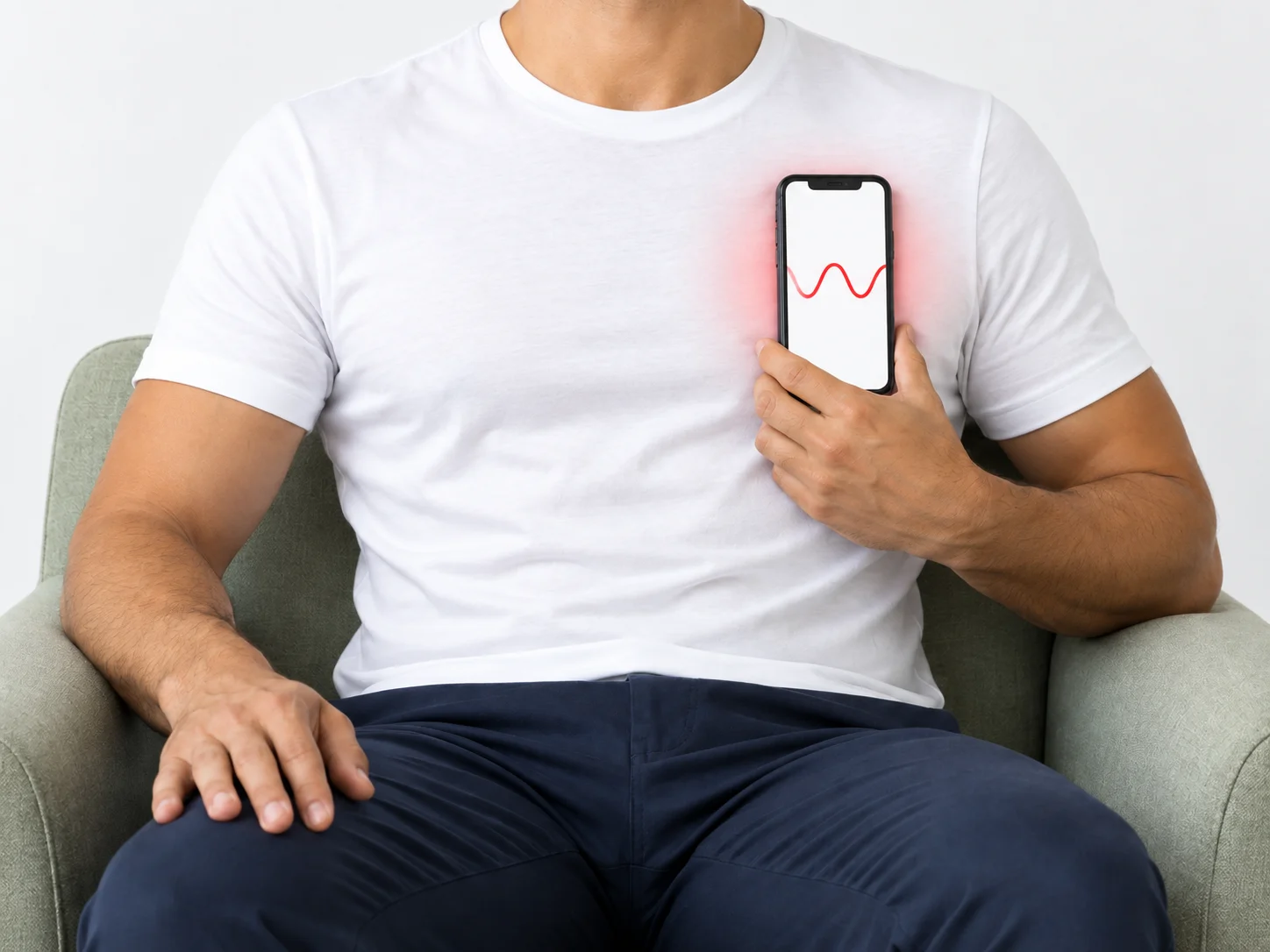
Faceless AI-generated seated illustration: screen facing out, phone back against the left chest above the heart.
Screen out · Phone back against the left chestAI-generated illustration, not a clinical photo. The screen is illustrative. See seated and lying-down guidance.

Preparation

5 sec

No capture during preparation

Recording window

30 sec

Stay still; breathe naturally

Requested sampling

100 Hz

Actual rate follows timestamps

After measuring

Review the recording

Estimates and curves saved locally

01 / SENSING THE MOTION

Find heart-related rhythms
within chest movement.

The iPhone accelerometer and gyroscope detect small movements. Signals may also contain breathing, hand movement and contact changes. This version focuses on heart-related motion and does not output breathing rate.

MOTION · A CONCEPTUAL VIEWIllustration, not recorded data
INPUT

Mixed chest motion

Rhythms and other motion may coexist

Conceptual curve: faster small movements over a slow drift, without a real time scale.
Focus on heart-related mechanical movement
CARDIAC MOTION

Heart-related movement

Acceleration (SCG) and angular motion (GCG)

Red conceptual curve showing repeating mechanical movement, not an ECG or actual recording.

These conceptual curves contain no measured values and do not prove filtering performance or accuracy. The app displays mechanical chest movement, not an ECG. A peak does not necessarily represent one heartbeat.

SCG · SeismocardiographyAcceleration sensing of small linear chest-wall movements associated with heart activity.

GCG · GyrocardiographyAngular-velocity sensing of small rotational chest-wall movements associated with heart activity.

02 / FROM SIGNAL TO ESTIMATE

An estimate needs more
than counting peaks.

Processing runs on the device. Timing integrity, movement interference and rhythm consistency affect the result. A smooth display does not establish accuracy.

  1. 01

    Sense and record

    Capture after preparation, keeping original sample timestamps.

    Acceleration · Rotation · Orientation
  2. 02

    Timing and processing

    Check intervals, resample and filter to analyze heart-related rhythms.

    Gaps are not continuous data
  3. 03

    Check interference

    Assess movement, transients, periodicity and signal agreement.

    Filtering cannot remove every disturbance
  4. 04

    Estimate, save and replay

    Use valid windows for estimates; preserve recordings for review and export.

    Insufficient evidence may yield no result

Keeping still is an important step in reducing interference.Talking, hand movement, clothing, contact pressure and device differences affect estimates. A displayed number does not remove these limitations.

03 / INSIDE PULSEREST

From the principle
to a visible record.

Principles and sources are available in onboarding and Settings. After measuring, review the recorded chest motion and export a single-measurement PDF.

  • 01
    A clearly qualified estimate

    Estimated heart rate only; no invented values when evidence is insufficient.

  • 02
    Replay the recording

    Retain the 30-second curve and export its PDF from the result or record details.

  • 03
    Check the source

    Open the paper directly; distinguish research from this implementation.

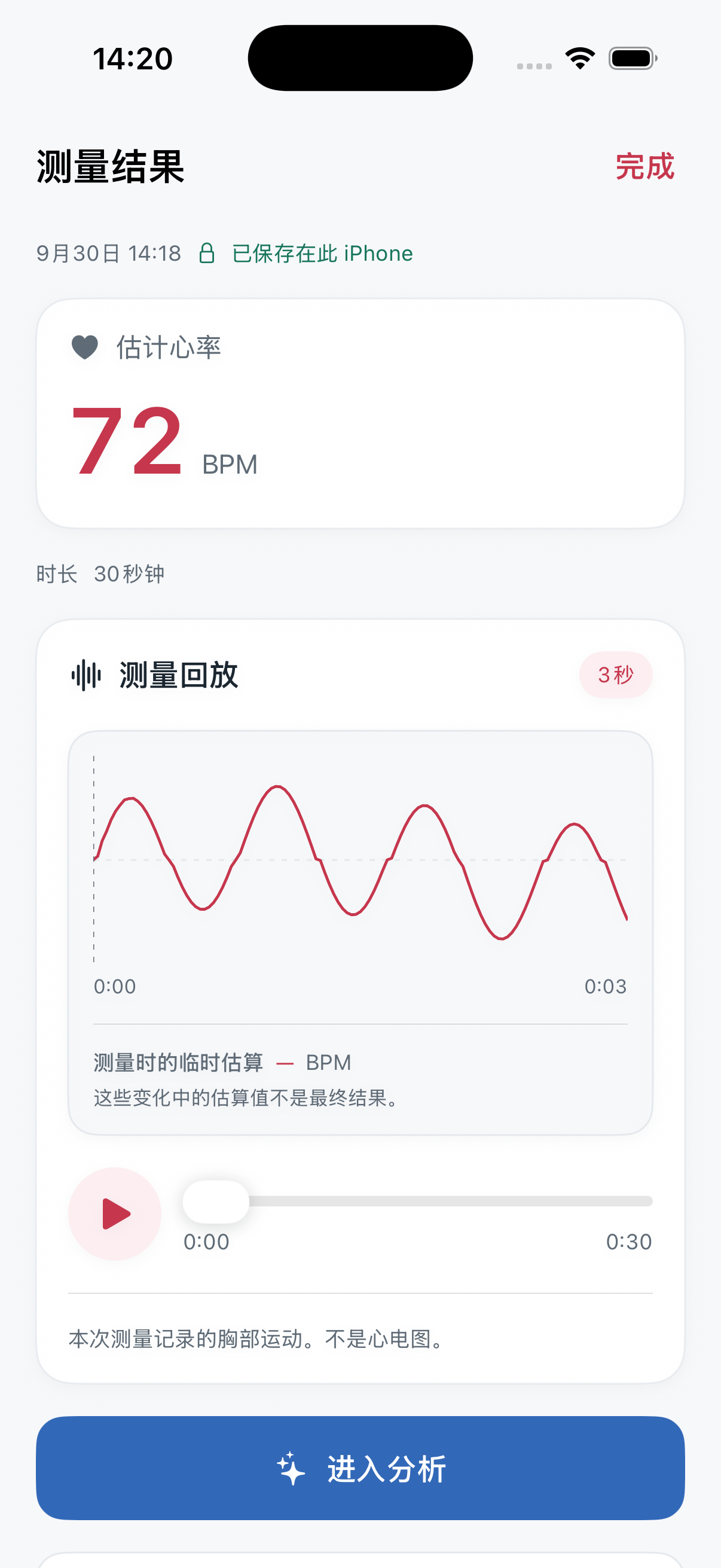
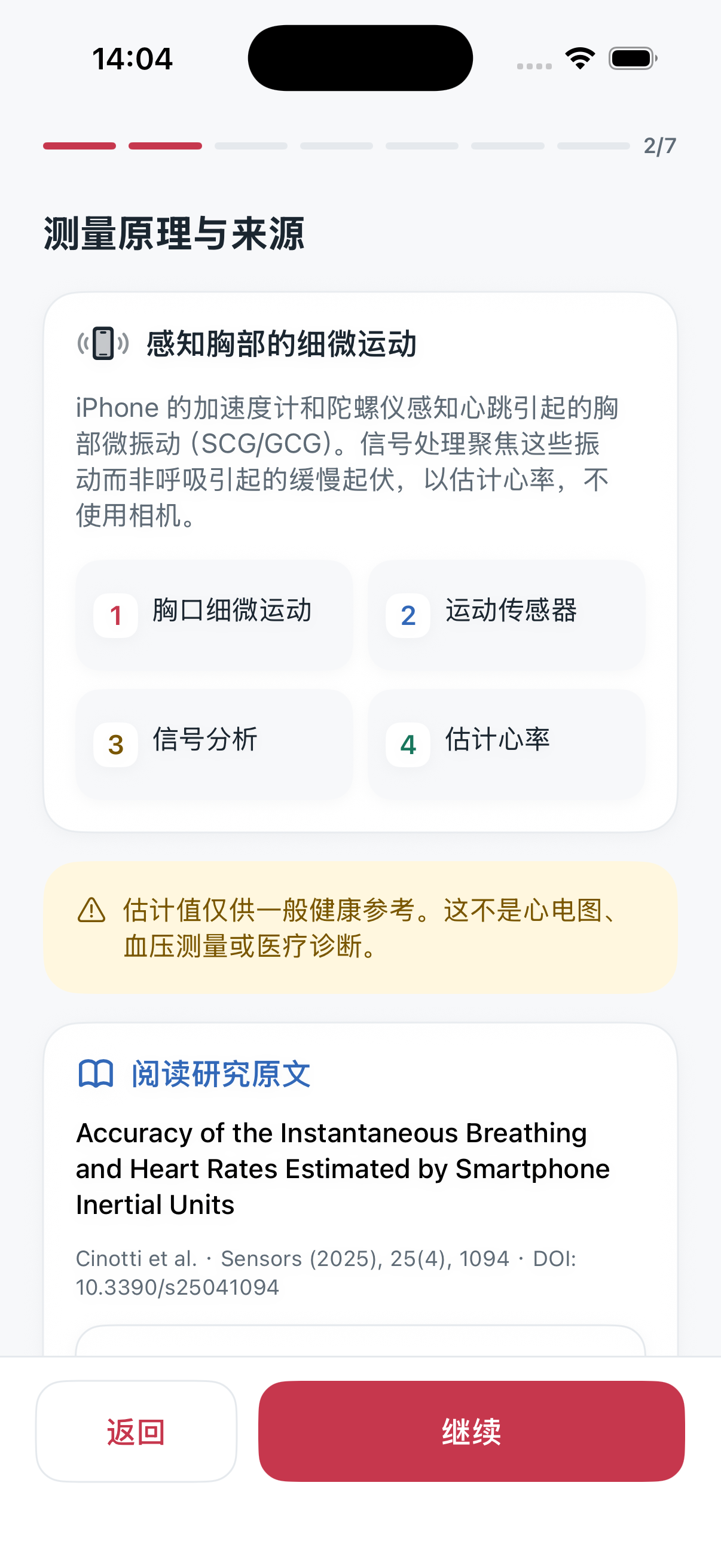
These preserved heart-rate-only simulator screenshots use example data. The 72 BPM figure and curves are not a person’s health records or accuracy evidence. Access and subscription screens may differ. Open images to enlarge them; swipe horizontally on narrow screens.

PulseRest result with estimated heart rate and chest-motion replay. The 72 BPM result and curve are simulated data.
SCREEN 01Estimate and replayNative UI · Simulated data
PulseRest onboarding explains chest motion, estimated heart rate, non-medical limits and the source paper.
SCREEN 02Principles and sourcesNative UI · Source links

04 / RESEARCH & TRANSPARENCY

Open about the source.
Open about its limits.

This research provides context for smartphone inertial sensing. It is not a PulseRest clinical trial or an endorsement by the authors.

PRIMARY REFERENCE · Original research

Accuracy of the Instantaneous Breathing and Heart Rates Estimated by Smartphone Inertial Units

Eliana Cinotti, Jessica Centracchio, Salvatore Parlato, Daniele Esposito, Antonio Fratini, Paolo Bifulco, Emilio Andreozzi.
Sensors, 2025, 25(4), 1094 · Published February 12, 2025
DOI: 10.3390/s25041094 · PMCID: PMC11859794

The study recorded an iPhone 8 on the chest of ten healthy resting, supine participants, compared with synchronized ECG and a respiratory belt. Sampling was 100 Hz, with heartbeat matching following manual template selection. See the paper for methods and limits (new window)。

IN THE STUDY

What the study investigated

  • Heart and breathing information under particular device and resting supine conditions.
  • Detection and interval estimates compared with synchronized references.
  • Limits including a small sample, one device and manual template selection.

IN THIS APP

How PulseRest uses the principle

  • Seated handheld and supine use, with seated guidance by default.
  • Automatic on-device processing; requested 100 Hz capture for 30 seconds, with actual rates determined from timestamps.
  • Heart-rate estimates only, without breathing-rate measurement or Apple Health sync. Saved curves support replay and PDF export; insufficient signals can require another measurement.

This page summarizes the background without reproducing paper figures or calling it the first discovery of SCG/GCG. PulseRest is an independent implementation, not a complete reproduction of the paper’s algorithm. Study data is not a product-accuracy promise.

BEFORE YOU RELY ON A NUMBER

Understanding limitations
is part of understanding a reading.

General wellness reference, not medical judgment.

Do not use estimates to diagnose, screen or treat disease, or change medication. Seek professional help for chest pain, breathing difficulty or fainting; do not wait for the app or AI.

When is a subscription required?

PulseRest provides measurement access during the first 7 × 24 hours from the original local first-launch time. Clear local data keeps that start. After the period ends, new measurements require active Pro access. AI always requires an active subscription verified on your device by Apple StoreKit, with up to 50 replies per device per local calendar day, resetting at local midnight. Existing history, replay, individual PDF export, deletion and past conversations remain available. See the Terms.

Is this an ECG? Can it measure blood pressure?

No. The phone senses mechanical motion rather than electrical heart activity. It does not measure blood pressure or blood oxygen, or identify disease.

Does it support both seated and supine use?

Both positions remain supported, with seated guidance shown by default. Keep the phone back against your left chest above the heart, screen facing out, and remain still. The cited study used resting supine conditions; seated handheld use is a different condition.

Why can a result be missing or unstable?

Movement, placement, clothing, sampling gaps and device differences may affect a result. Insufficient evidence can prevent an estimate. A displayed number is not a reason to disregard placement or make medical decisions.

Is information automatically sent to AI?

No. With active Pro access, sharing consent and an explicit send, selected results and the first request’s processed waveform pass only through our ECS servers to DeepSeek or Poyo. After the first complete reply is saved, follow-ups omit the waveform; an initial retry, an unsaved reply or a fallback may send the initial context again. Raw multi-axis recordings and the full PDF are not sent. The app contains no provider key or direct-provider route. Apple-signed purchase evidence goes only to ECS to authorize or renew a short-lived AI session, not to AI providers. Daily usage stays on your device; a valid session is reused for requests. AI cannot verify measurement accuracy. Read the Privacy Policy.

中文摘要

从胸口微振动,到估计心率。

PulseRest 利用 iPhone 惯性传感器估计心率:5 秒准备不采集,随后记录 30 秒;支持静坐和仰卧,请求采样率 100 Hz,实际频率按时间戳统计。胸部机械运动不是心电图。本版本不测呼吸频率、血压,也不读取或同步 Apple 健康。研究同时讨论呼吸,但论文范围不等于 App 功能。论文不是本 App 临床试验、准确性承诺或作者认可;图示和截图不作为验证证据。

首次打开 App 后有本机记录的连续 7 × 24 小时测量体验期,清除本地数据保留起点。到期后新测量需有效 Pro;AI 从开始就需本机 Apple StoreKit 验证的有效 Pro,每台设备每天的回复上限为 50 次,当地时间 00:00 重置。原有记录、回放、单次 PDF、删除和旧聊天保持可用。AI 经明确同意并主动发送后,仅由公司 ECS 转发至 DeepSeek 或 Poyo;首轮可附处理波形;首个完整回复保存后,追问不重复附波形,首轮重试、回复未保存或容灾转发仍可能再次发送首轮上下文。不上传原始多轴记录或完整 PDF。首次取得或更新短期 AI 会话时,Apple 签名购买凭据仅交 ECS,不提供给 AI 供应商;日常请求复用有效会话,每日计数保留在本机。查看权益条件 · 隐私政策。